 by
by 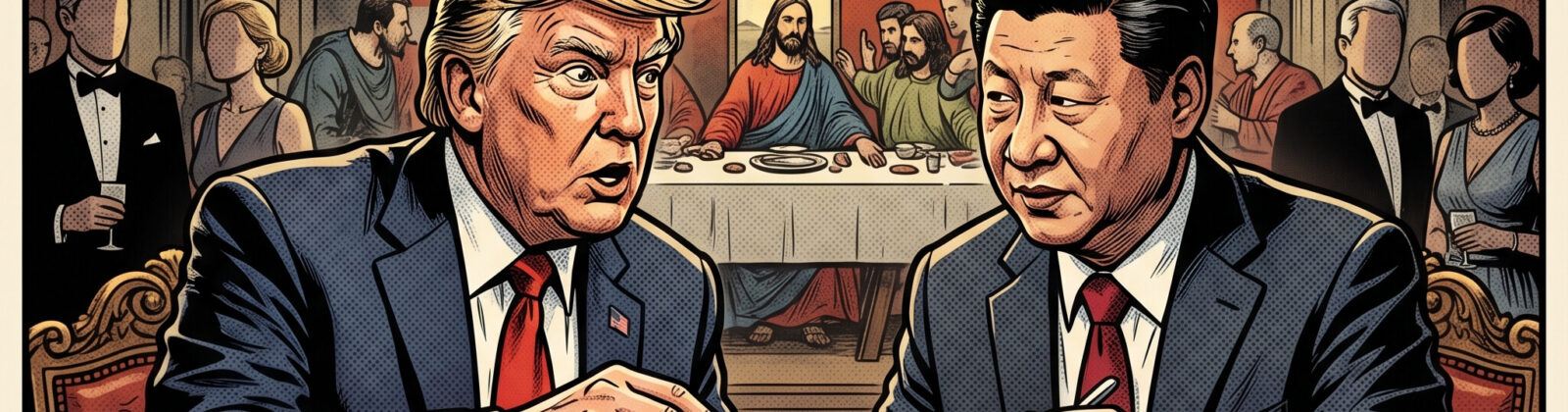
Xi and Trump Sit at the Last Supper: The War We Foresee

The Beijing state dinner — May 14, 2026. Two leaders, one table, a shadow neither named.
Beijing, May 14, 2026. The chandeliers in the Great Hall of the People burned bright. Red carpet. Blue and gold balconies. A pagoda-roofed backdrop framed in U.S. and Chinese flags. President Donald Trump walked down a wide staircase, flanked by a delegation of America’s wealthiest CEOs — Elon Musk, Jensen Huang, and roughly a dozen more — and raised a glass to Xi Jinping. Xi raised one back. The two men called each other friends. They spoke of cooperation. They smiled.
And underneath that smile, a question hung in the air like incense over a banquet table that no one in the room wanted to name out loud:
Is this the last supper before the war?
That is not hyperbole. It is not even my framing. It is, almost word-for-word, the framing Xi Jinping himself brought to Trump just hours before the toast.
The Banquet That Looked Like a Painting
Watching the footage of this state dinner, I could not stop thinking about Leonardo da Vinci’s The Last Supper. Twelve disciples around a table with Christ at the center. Wine. Bread. Laughter. And one man — Judas — already in the deal. Already counting his silver.
The Last Supper, in Christian theology, was not an accident. It was prophesied. Psalm 41:9 had foretold the betrayal — the close friend who shared bread. The meal was procedural. It had to happen. The crucifixion was the next chapter, and the disciples didn’t know it yet — except the One who knew it all along, and the one already plotting in the dark.
I’m not comparing Trump to Jesus. No one compares to Jesus. And I’m not casting Xi as a literal Judas. What I am saying is this: when two leaders sit at a polished table, raise gilded glasses, and call each other friends while one of them is openly arming for a war with the other, the imagery writes itself. Fine wine. Slow steps. Choreographed laughs. And underneath it all — the clock.
This is what made today’s dinner so unsettling. Not the menu. The subtext.

Be careful who you have dinner with — the conversation that wasn’t reported, but should have been.
When Xi Whispered the Word “Thucydides”
Here is the line that should have stopped every American cold.
Before the bilateral meeting even started, Xi looked at Trump and asked whether the two countries could overcome the “Thucydides Trap and create a new paradigm of major country relations”. Xi has been using that phrase publicly since 2014. He didn’t have to use it today. He chose to.
For anyone unfamiliar: the Thucydides Trap is a concept popularized by Harvard’s Graham Allison, drawn from the ancient Greek historian Thucydides, who wrote of the Peloponnesian War: it was the rise of Athens, and the fear that this instilled in Sparta, that made war inevitable. Allison studied 500 years of history and identified 16 cases where a rising power challenged a ruling one. Twelve of those sixteen ended in war. Only four avoided it.
That’s a 75% historical failure rate.
And the Chinese leader, sitting across from the American president, raised that exact framework as the question of the evening.
Read that again. The man who controls 1.4 billion people, the world’s second-largest economy, the world’s largest navy by ship count, and the country that has openly warned America not to defend Taiwan — that man invoked the most famous academic theory for why rising powers and ruling powers go to war. He invoked it to Trump’s face. With cameras rolling. With wine being poured.
If that doesn’t make the hair on the back of your neck stand up, you weren’t paying attention.
Ray Dalio’s Big Cycle: Why This Dinner Was Inevitable
Billionaire investor Ray Dalio, founder of Bridgewater Associates — the largest hedge fund in the world — spent years studying the rise and fall of empires over the past 500 years. The Dutch. The British. Now the Americans. His framework, laid out in Principles for Dealing with the Changing World Order, is brutally simple:
Empires rise on education, innovation, competitiveness, military strength, trade, financial center status, and reserve currency dominance. They decline when debt explodes, internal political conflict deepens, productivity slows, and a new power begins outcompeting them on those same metrics.
Dalio’s verdict on America is unsparing. By his measures:
- Federal debt surpassed 120% of GDP in 2025 — a level last seen in World War II.
- U.S. productivity growth has fallen from 2.8% annually in the late 1990s to under 1.4% in the 2010s.
- OECD PISA scores in math and reading among American students declined from 2000 to 2018.
- China has risen from about 1% of global GDP in 1980 to roughly 19% (by purchasing power parity) today.
Dalio doesn’t just say America is slipping. He has warned of a possible financial heart attack — a debt-driven crisis that could break the dollar’s reserve status and trigger the same kind of disorderly transition Britain went through after World War II.
And here is the most chilling Dalio insight of all: he places the United States today in stages 6–8 of his Big Cycle. Stage 6 is internal disorder. Stages 7 and 8 are war and the changing of the guard.
That is where he places us. Right now. Today.
So when Xi sat across from Trump and asked, can we avoid the Thucydides Trap? — what he was really saying is: we both know the trap is the playing field. Now what?
The General Who Said the Quiet Part Out Loud
In 2025, U.S. Air Force Brigadier General Doug Wickert, commander of the 412th Test Wing, gave a 40-minute briefing — now seen by more than 400,000 people on YouTube — warning that China is preparing a Pearl Harbor–style surprise attack on the United States as part of a broader campaign to take Taiwan.
That is a U.S. one-star general. On video. Saying it out loud.
He is not alone.
- The U.S. House Select Committee on the CCP declared last year that “the window to deter war with China is closing fast.” Chairman John Moolenaar bluntly told Americans: 2027 is not an American date — it’s a Chinese one, referring to Xi’s order for the People’s Liberation Army to be ready to seize Taiwan by force.
- CIA Director William Burns confirmed U.S. intelligence knows “as a matter of intelligence” that Xi ordered his military to be ready by 2027.
- Former INDOPACOM commander Adm. John Aquilino told Congress that “all indications” point to the PLA meeting that 2027 directive.
- Current INDOPACOM chief Adm. Samuel Paparo described recent Chinese drills around Taiwan as “rehearsals” demonstrating “clear intent and capability.”
And what would that attack look like? Not necessarily an armada steaming toward Hawaii. Today’s Pearl Harbor would likely be fought in space — knocking out U.S. imaging satellites at the “solar moon” phase of orbit using ground-based anti-satellite lasers China has already deployed in Xinjiang. In cyberspace — crippling logistics, communications, and the electromagnetic spectrum. In our ports — through cruise missiles hidden in cargo containers aboard the 5,997 Chinese-registered merchant ships that sail the world’s oceans. China is the world’s largest producer of small drones. Beetle bombs. Containerized YJ-18 missiles. The opening move could come from a container ship sitting in Long Beach.
Pearl Harbor 1941 came from carriers steaming across the Pacific. Pearl Harbor 2.0 may come from low-Earth orbit, a fiber-optic cable, and a freighter no one is watching.
CSIS Ran the War 24 Times. Here’s What They Found.
The Center for Strategic and International Studies wargamed a Chinese invasion of Taiwan 24 separate times. In most scenarios, the U.S. and its allies “won.” But the price tag should sober every American:
- Two U.S. aircraft carriers sunk.
- 10 to 20 large surface combatants destroyed.
- Approximately 3,200 U.S. troops killed in just three weeks — nearly half the U.S. death toll from two decades of fighting in Iraq and Afghanistan.
- Hundreds of U.S. aircraft destroyed, the vast majority on the ground, by Chinese missile strikes. One iteration: 900 U.S. warplanes lost in four weeks — roughly half the combined combat aircraft of the U.S. Air Force and U.S. Navy.
- Japan loses more than 100 aircraft and dozens of ships.
- Taiwan’s entire fleet of 26 destroyers and frigates: sunk.
- China loses about 10,000 troops, 155 combat aircraft, and 138 major ships. Its navy, in CSIS’s words, is left “in shambles.”
CSIS called it what it would be: a pyrrhic victory. We “win” — and our global position is wrecked for a generation.
And the report says it plainly: there is no Ukraine model for Taiwan. Once shooting starts, you can’t resupply the island. Whatever Taiwan is fighting with, that’s what it has.
That is the cost of the war Xi just hinted at across a dinner table.
I Said This in 2013. I Said It Again in 2022.
In 2013, I publicly warned that a war between Russia, China, and America was coming. People thought I was being dramatic.
In 2022, when Russia invaded Ukraine, I told whoever would listen: we are already at war with Russia and China. People still thought I was being dramatic.
It is now 2026. America is on one side of three live conflicts — Russia, Venezuela, and Iran. China is on the other side of all three. Russia, China, and North Korea have stitched together a formal alliance for the first time in modern history — exactly what I said would happen back in 2013. North Korea wants reunification with the South. Russia wants to rebuild the Soviet sphere. China wants Taiwan. Iran wants the entire Middle East — and has already taken effective control of the Strait of Hormuz.
These are not separate stories. They are one story.
You no longer need a prophet to see it. You just need eyes.
What Xi Actually Said About Taiwan Today
Don’t take my word for the temperature in the room. Take Xi’s.
According to Chinese Foreign Ministry spokesperson Mao Ning, Xi told Trump directly that the Taiwan question is the most important issue in U.S.–China relations. Handle it well, the relationship holds. Handle it badly, and the two countries will face “clashes and even conflicts, putting the entire relationship in great jeopardy.”
Mao Ning, posting on X, sharpened it further: Taiwan independence and cross-Strait peace are as irreconcilable as fire and water.
Fire and water. That was the diplomatic temperature of the dinner.
And here is the part most Americans missed: Xi is not threatening. Xi is informing. He is telling Trump — and through Trump, telling us — that the line is drawn. Beijing has been telling us this for years. We just keep not believing them.
The Choreography of a Frenemies’ Last Supper
Look closely at the optics of today and you can see two leaders performing peace while preparing for war:
- Trump brought America’s wealthiest CEOs to Beijing — what he described as the “top 30” companies, every one of whom said yes to the trip. A flex. A flotilla of capital.
- Xi agreed Iran cannot have a nuclear weapon and that the Strait of Hormuz must remain open — useful concessions in the middle of an active U.S. war with Iran.
- China reportedly agreed to buy 200 Boeing jets.
- Trump invited Xi to the White House on September 24.
- The two sides announced a framework for a “constructive China-U.S. relationship of strategic stability.”
That all sounds wonderful. It is also, almost word-for-word, the kind of language exchanged between great powers right before a war they both said they didn’t want.
Meanwhile — at the same time — Trump is arming Japan. He is reinforcing the Philippines. He is sending more weapons to Taiwan. Xi is running constant invasion rehearsals around the Taiwan Strait. China is building amphibious lift, anti-ship ballistic missiles, hypersonics, ASAT lasers, and the world’s largest navy. Both men kissed each other on the cheek tonight. Both men are laying the table for the war they keep promising they don’t want.
That is the duplicity of this moment. That is why this state dinner is haunting.
So Is This Really the Last Supper?
I will not pretend to know the day or the hour. No one does.
But here is what I will say. The Last Supper was prophesied. It had to happen. The room was warm. The wine was good. The men at the table called each other friends. And then the world changed.
We are sitting at a table just like that.
The historical base rate of a Thucydides Trap ending in war is 75%. The Chinese president invoked that exact framework today. The Chinese military has been ordered to be ready by 2027. A serving U.S. general has publicly warned of a Pearl Harbor–style surprise attack. The world’s most respected investor says America is in the late, dangerous stages of an empire-defining cycle. And the two countries leading the world have just had the most cordial, dangerous, weirdly beautiful state dinner of the 21st century.
Maybe I am wrong. I pray I am.
But if history rhymes — and Thucydides, Allison, Dalio, and the Bible all suggest that it does — then years from now, historians may look back at the footage of May 14, 2026, the way we look back at handshakes from the summer of 1939. Two men. A long table. A polite toast.
And then the camo came out.
What Americans Should Be Doing Right Now
I don’t end with despair. I end with what we should do:
- Take Xi at his word. When the leader of a nuclear-armed superpower invokes the Thucydides Trap to your president’s face, that is not small talk.
- Demand harder questions of our leaders. Are our bases in Japan and Guam hardened against missile attack? Are our shipyards keeping up? Are we arming Taiwan now — before shooting starts, because CSIS proved you can’t do it after?
- Understand the Pacific is China’s home field. Wargames are not run on neutral ground. The South China Sea is their backyard. We would be the away team.
- Pray. Seriously. I don’t say this as a slogan. I say it as someone watching the cycle Ray Dalio described turn faster than even he thought possible. The Bible says the kingdoms of this earth will give way. I believe a great destruction in this season may be the gateway to the world government foretold in Scripture. That is a longer conversation. But it starts with prayer right now.
The cameras will leave Beijing. The chandeliers will dim. Trump will fly home. Xi will go back to work.
And the question that lingered over the table tonight — are we frenemies or enemies? — has, I believe, already been answered.
We just have not been told yet.
Further Reading: Books That Predicted This Dinner
If this post sparked questions — and I hope it did — the men I cited in this article have all written books that go deeper than a blog post ever can. Here are the ones I’d put at the top of your stack, with links so you can grab them today:
1. Destined for War: Can America and China Escape Thucydides’s Trap? — Graham Allison
This is the book on the framework Xi just invoked to Trump’s face. Harvard’s Graham Allison studies 500 years of history, identifies 16 cases of a rising power challenging a ruling one, and shows that 12 ended in war. Henry Kissinger, Joe Biden, Kevin Rudd, and Niall Ferguson have all called it a must-read.
→ Get it on Amazon
→ Allison’s Thucydides’s Trap research page at Harvard’s Belfer Center
2. Principles for Dealing with the Changing World Order — Ray Dalio
The billionaire investor’s 500-year study of empires, debt cycles, and the rise and fall of reserve currencies. This is where the “Big Cycle” framework I quoted comes from. Endorsed by Henry Kissinger, Tim Geithner, and Jamie Dimon.
→ Get it on Amazon
→ Free PDF of Dalio’s original article series at economicprinciples.org
3. The Hundred-Year Marathon: China’s Secret Strategy to Replace America as the Global Superpower — Michael Pillsbury
Pillsbury served in senior national security roles under every president from Nixon to Trump. He speaks fluent Mandarin and spent four decades talking to China’s hawks. His thesis: China has a hundred-year plan, ending in 2049, to displace America “without firing a shot.” A wake-up call for anyone still telling themselves China is a peaceful rising partner.
→ Get it on Amazon
4. Plan Red: China’s Project to Destroy America — Gordon G. Chang
Gordon Chang is the analyst I quoted in my opening section — the one who has been warning that the Chinese people see America as already in decline. Plan Red is his most aggressive book yet: a detailed argument that Xi Jinping is mobilizing China for war and that the largest military buildup since World War II is happening right now, in real time. If you want the unvarnished hawk’s case, start here.
→ Get it on Amazon
→ Barnes & Noble
5. Danger Zone: The Coming Conflict with China — Hal Brands & Michael Beckley
A different angle that I want you to read alongside the others. Brands (Kissinger Distinguished Professor at Johns Hopkins) and Beckley (Tufts) argue China is most dangerous not when it’s strong and rising, but when it senses its window of opportunity is closing — demographics collapsing, economy slowing, military advantage peaking. Their thesis: the “danger zone” is now through the late 2020s. This explains why 2027 keeps coming up.
→ Get it on Amazon
6. The Landmark Thucydides: A Comprehensive Guide to the Peloponnesian War — Thucydides (Robert Strassler, ed.)
The original. Twenty-five hundred years old and still the playbook every modern strategist reads. If Xi is going to keep using Thucydides’s name in negotiations with American presidents, then we ought to read what Thucydides actually wrote. The Landmark edition is the one to get — maps, footnotes, and historical context throughout, edited by Robert Strassler with an introduction by classicist Victor Davis Hanson.
→ Get it on Amazon
Beyond the Books — Primary Sources You Should Actually Read
If you want to verify everything I cited in this post, here are the primary documents:
- The CSIS wargame report (“The First Battle of the Next War: Wargaming a Chinese Invasion of Taiwan”) — Read the full PDF at CSIS
- Brig. Gen. Doug Wickert’s full Pearl Harbor warning speech — Watch on YouTube (already at 400,000+ views)
- The House Select Committee on the CCP — Their press releases and hearings on the closing window with China
- Today’s Trump-Xi state dinner coverage — CNN live updates, NBC News live blog, CNBC five takeaways
- The Hill’s explainer on Xi raising the Thucydides Trap with Trump — Read here
I am not in any of these authors’ camps entirely. Allison is more measured than Chang. Brands and Beckley are more analytical than Pillsbury. Dalio is more economic than military. Read all of them. That is how you triangulate the truth. That is how you stop being shocked by what is already in front of you.
What do you think? Was this the Last Supper between America and China — the moment we look back on as the obvious foreshadowing? Drop a comment. Share this post. And keep your eyes open. The next chapter is being written in real time.

Leave a Reply