 by
by 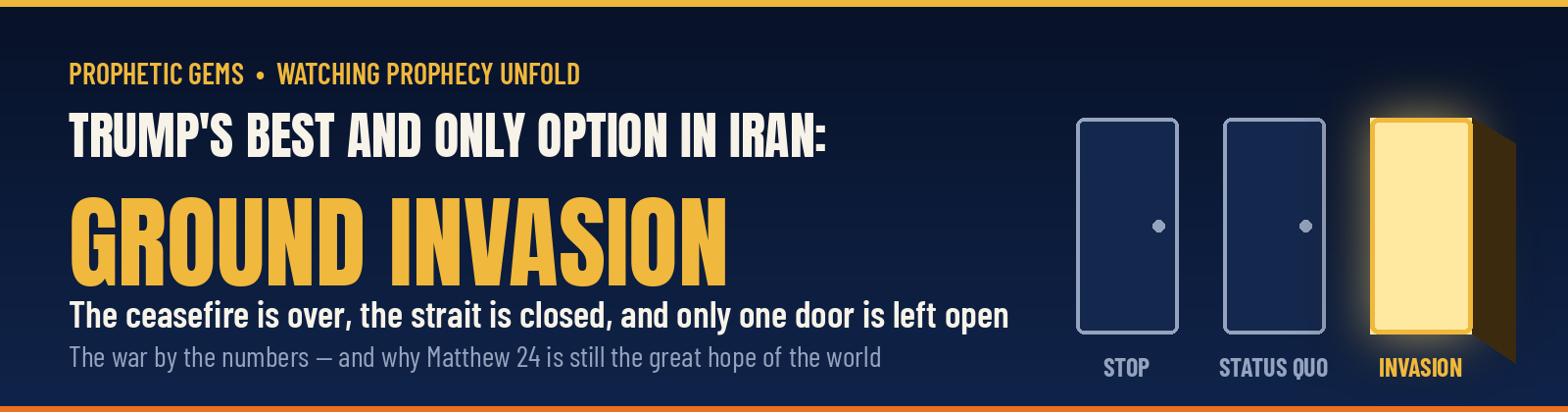
She said it before I could get the words out of my mouth: the worst thing that could happen right now is that everything stays the same. And that is exactly where we are. On July 8, 2026, standing at the NATO summit in Ankara, President Trump declared that the ceasefire with Iran is over. The 14-point Memorandum of Understanding he signed just three weeks earlier at the Palace of Versailles — over. And what did we go back to? Not victory. Not a deal. We went right back to the same unsustainable status quo we had before: Iran firing drones and missiles, tankers burning in the Strait of Hormuz, gas prices climbing, and America striking and pausing, striking and pausing, while the clock runs in Tehran’s favor. I’m going to say plainly what Washington keeps dancing around: there is only one way out of this now, and it’s a ground invasion of Iran.
That’s the whole idea of this post, and I’m not going to bury it: every other option has already been tried, measured, and found wanting. I want to walk you through what actually happened — with the real numbers, because the numbers tell the story — and show you why Trump is stuck between Iran and a hard place, why every door except one leads right back to where we started, and finally why, as fearful as all of this looks with natural eyes, Matthew 24 is the great hope of the world right now.
We Went Back to War — and Back to the Same Bad Status Quo
Here is the problem with ending the ceasefire without a new strategy: you are not moving forward, you are rewinding the tape. Do you remember what happened before the ceasefire? Because I do, and the receipts are staggering.
The war kicked off on February 28, 2026, when U.S. and Israeli strikes opened Operation Epic Fury — strikes that killed Supreme Leader Ali Khamenei himself. Iran answered with waves of missiles and drones against Israel, against the Gulf states, against U.S. bases across the region, and it slammed the Strait of Hormuz shut. From February 28 to the ceasefire on April 8, we fought for roughly 40 days straight. In just the first three-plus weeks, CENTCOM reported more than 8,000 combat flights, over 8,000 targets hit, and around 130 Iranian vessels destroyed. I used to say “over 2,000 sorties” from memory — the real number was four times bigger than that. And still it wasn’t enough to break them.
And Iran hit back in ways nobody expected. On March 19, a U.S. Air Force F-35A — the crown jewel of American air power, a jet that costs north of $100 million — was struck by suspected Iranian ground fire over Iran and forced into an emergency landing at a base in the Middle East, the pilot wounded by shrapnel. It didn’t crash, but it was hit, and that was the first combat-related emergency landing in the F-35’s history. Two weeks later, on April 3, Iran did shoot down a U.S. F-15E Strike Eagle over its territory. Three more F-15s had already been lost to a friendly-fire incident with Kuwaiti air defenses on day two of the war. The “unkillable” American air armada was bleeding.
Then there was the economic bleeding. The blockade of Hormuz produced the largest supply disruption of the global oil market in history. Brent crude spiked to roughly $112 a barrel at the March peak. By June 16, the war’s cost to the American taxpayer was estimated at $113.3 billion. Our weapons stockpiles were being drained, our Treasury yields and national debt were flashing warning lights, and our ability to deter China and Russia was being spent in the Persian Gulf. That — the financial catastrophe — is why Trump and Vice President Vance moved for a ceasefire. Trump said it himself when he defended the deal: he did not want to see an economic catastrophe.
The Timeline: How the Ceasefire and the MOU Rose and Fell
Let me lay out the whole sequence, because if you only caught pieces of this on the news, the order of events matters. This is the anatomy of a ceasefire that was never really a ceasefire:
- February 28, 2026 — The war begins. U.S.-Israeli strikes kill Khamenei and other Iranian leadership. Iran blockades the Strait of Hormuz and rains missiles and drones across the region.
- April 8, 2026 — After about 40 days of fighting, both sides agree to a two-week ceasefire mediated by Pakistan. Within a day, Iran refuses to reopen Hormuz and accuses the U.S. and Israel of violating the truce in Lebanon.
- April 12–13, 2026 — The Islamabad peace talks fail. The U.S. answers with a naval blockade of Iran.
- April 21, 2026 — Trump extends the ceasefire indefinitely. What follows is two months of “high-stakes ambiguity” — a ceasefire violated again and again by both sides.
- June 17, 2026 — The 14-point Memorandum of Understanding is signed: Trump at the Palace of Versailles, President Pezeshkian in Tehran. The MOU formalized the ceasefire, ended the U.S. naval blockade, reopened the Strait of Hormuz, dangled sanctions relief and oil waivers in front of Iran, and opened a 60-day window to negotiate a permanent deal — including nuclear inspections and the removal of Iran’s buried nuclear “dust.”
- Late June 2026 — Iranian drones hit tankers like the M/V Ever Lovely and M/T Kiku in the strait. The U.S. strikes back three times in three weeks. The pattern sets in: Iran hits shipping, America retaliates, Iran hits Gulf allies.
- July 7–8, 2026 — The pattern breaks. CENTCOM hits more than 80 targets one night and 90 the next in “offensive” strikes on Iran’s coastline, including Kharg Island — the hub that handles roughly 90% of Iran’s crude exports. Iran retaliates against U.S. bases in Kuwait, Bahrain, and even triggers alerts in Jordan. Trump declares the ceasefire “over.”
So what was the MOU really? It solved the easy problems — blockades and paperwork — and kicked the two impossible ones down the road: Iran’s nuclear program and who actually controls the Strait of Hormuz. Iran’s chief negotiator Ghalibaf declared that Hormuz will only open under Iranian arrangements, never under American threats, and that this conflict will never end with Iran’s surrender. Vance has been just as blunt from our side: that artery has to stay open. Two non-negotiables pointed directly at each other. That is not a peace framework. That is a countdown.
Stuck Between Iran and a Hard Place
Now here is the part most commentators are missing: the Gulf states. Saudi Arabia, the UAE, Kuwait, Bahrain, Qatar — they are stuck between Iran and a hard place. (It would have been an easier pun if it were Iraq, but I digress.)
Every time America strikes Iran, Iranian missiles and drones come down on Gulf soil. Bahrain has absorbed hundreds of missiles and thousands of drones since this war began. The UAE has engaged over 500 ballistic missiles and more than 2,200 drones. These nations make their money on three things — oil, natural gas, and tourism — and all three are held hostage by Iranian weapons. If the Gulf states back Iran’s demands, they invite domination by Tehran. If they fully back America and Israel and the IRGC falls, they strengthen Israel and potentially open their own populations to freedom movements their monarchies fear. And remember: hostility toward Israel remains popular on the Arab street even where governments cooperate quietly. So the winds of Gulf support shift back and forth, and you never know how they will land. Trump is playing his hand with that ambiguity in mind — and so is Iran.
The Strait of Hormuz: Held Hostage by Drones and Missiles
Roughly one-fifth of the world’s oil passes through the Strait of Hormuz. Other than the battlefields of Ukraine, it is the most dangerous place on Earth right now. Even after the MOU “reopened” it, the strait never came fully back to life — as of July 10, only about 15 commercial vessels transited the waterway in a 24-hour period. Shipping traffic is muted, insurance rates are brutal, and a UN maritime effort to move stranded vessels through an alternate Omani coastal route was halted the moment Iranian drones started flying again.
Here is the hard military truth: America cannot find and destroy Iran’s drones and ballistic missiles efficiently or fast enough from the air. We proved that over 40 days and 8,000-plus targets. These are cheap, mobile, concealable weapons, and Iran can restock them — with China and Russia still in Tehran’s corner diplomatically and economically, time is on Iran’s side, not ours. The experts have said it plainly, and I agree with them: the longer this drags on, the more it favors Iran. They restock and adapt while our economy takes hits, our stockpiles shrink, our national debt climbs, and the war grows less popular at home with the midterms just four months away. Even oil prices started climbing again within hours of Trump declaring the ceasefire dead.
Trump’s Best and Only Option: A Ground Invasion
Let’s be honest about the board. Regime change from the inside? Not happening — Khamenei was buried in Mashhad on July 9 and his son Mojtaba has already taken the mantle. The IRGC still runs the country. A real nuclear deal? Also not likely — Iran’s entire leverage comes from harassing the Gulf and holding Hormuz hostage, and the one thing they will not surrender is the nuclear program, because it is their ultimate insurance policy. Generals like Jack Keane and Keith Kellogg said it before the ceasefire and events have proven them right: you cannot trust this regime to honor a paper agreement. Trump got them on record with the MOU — that was smart strategy, it exposed them before the world — but exposure is not enforcement.
So walk through the three doors with me. Door one: stop the war. Then Iran rebuilds, restocks, and finishes its nuclear weapon — the very thing this entire war was fought to prevent. Door two: the status quo — strike and pause, strike and pause, forever. Then we bleed money, weapons, and political will while Iran bleeds nothing it can’t replace, and eventually they get the bomb anyway. Door three: a ground invasion that physically removes the IRGC’s grip on the coastline, the missile fields, and the nuclear program. It is the option nobody wants, it is the option with the highest cost, and it is the only option that actually ends this.
I am confident this is where Trump lands, and my read is that he starts moving after the midterms — that is when the political calendar and the military calendar line up. But even door three carries enormous questions. Where do you stage a ground force of that size? Which Gulf state, stuck between Iran and a hard place, is willing to host the invasion of Iran from its own soil and eat the retaliation that comes with it? Turkey? Pakistan? The Gulf monarchies? Every staging option is a diplomatic minefield. There are no good options on this board. Hold that phrase, because it is the doorway to everything I really want to tell you.
Why Matthew 24 Is the Great Hope of the World
What I see on Earth is fearful and not good. But what I see with faith is good. “Now faith is the substance of things hoped for, the evidence of things not seen” (Hebrews 11:1). So let me tell you what I see with faith.
Iran is very likely going to get a nuclear weapon eventually, or die trying, and in earthly terms that is a really bad thing. But here is the paradox: God is using even this to bring about the beautiful fulfillment of Bible prophecy. Look at the top of the funnel. Russia is on the war path and can revitalize quickly from its losses in Ukraine. Turkey is a military monster with enormous assets. Iran has been on a 47-year war footing since 1979 and can rebuild fast with friends in Moscow and Beijing. The world is fragmenting into a multipolar order full of strife — wars and rumors of wars, famines, earthquakes and pestilences in diverse places, exactly as Jesus described in Matthew 24. Deception everywhere. Lots of deception.
For a couple of years now I have been saying there are no good options — and now the whole world can see it. That is not an accident. I call it the Funnel of Peril — every crisis narrows the world’s choices — and I’ll be dedicating a full post to that funnel very soon, so consider this the preview. America must decline for the prophetic order to emerge — and we are watching that decline in real time: $113 billion spent, stockpiles drained, allies at NATO turning us down when we ask for help. Out of that fragmented, exhausted, chaotic world comes the demand for someone — anyone — to bring order. First a one-world government. Then the Antichrist rising to its head, offering a false peace the world will be desperate enough to embrace. Then the rapture of the church, and seven years of tribulation — the time Jesus called the most perilous in human history, with Israel at the center of it and the whole world shaking around it.
Before Trump ever took office this term, I said it plainly: I believe Trump will do well, but Trump is not God. He is doing well. But no president can pull America out of what has already been prophesied. We are being squeezed — you, me, the nations, everything — through the Funnel of Peril. And here is why that is the great hope and not the great terror: the funnel has a bottom, and at the bottom is not the Antichrist, not nuclear fire, not economic collapse. At the bottom is the Return of Jesus Christ. “And then shall they see the Son of man coming in the clouds with great power and glory” (Mark 13:26; Matthew 24:30). The same chapter that lists the sorrows lists the salvation. That is why Matthew 24 is the great hope of the world right now.
Faith Is the Substance of Things Hoped For
So watch the headlines, but read them with both eyes open — one on the earth and one on the Word. The ceasefire that wasn’t a ceasefire, the MOU that couldn’t hold, the strait that won’t open, the invasion that is coming: these are not random chaos. They are mile markers. Down here, the only way out for America is through — a ground invasion that finally ends what airpower alone could not. But eternally, the only way out for any of us has always been Jesus Christ, and these perilous times are pressing every one of us toward the moment when we have to decide what we believe. Don’t wait until the squeeze gets tighter. Get right with God today, get in His Word, and get watching — because everything Jesus said would happen is happening right before our eyes.
If this word stirred something in you, I’d love for you to share your own testimony and walk through these prophetic times with us here at PropheticGems. Keep the faith, keep watching, and remember: the darker it gets, the closer we are to the Light.

Leave a Reply