 by
by 
Geopolitics & Prophecy
Is Trump Detoxing China from Cheap Oil?
Last Call at Xi’s Bar
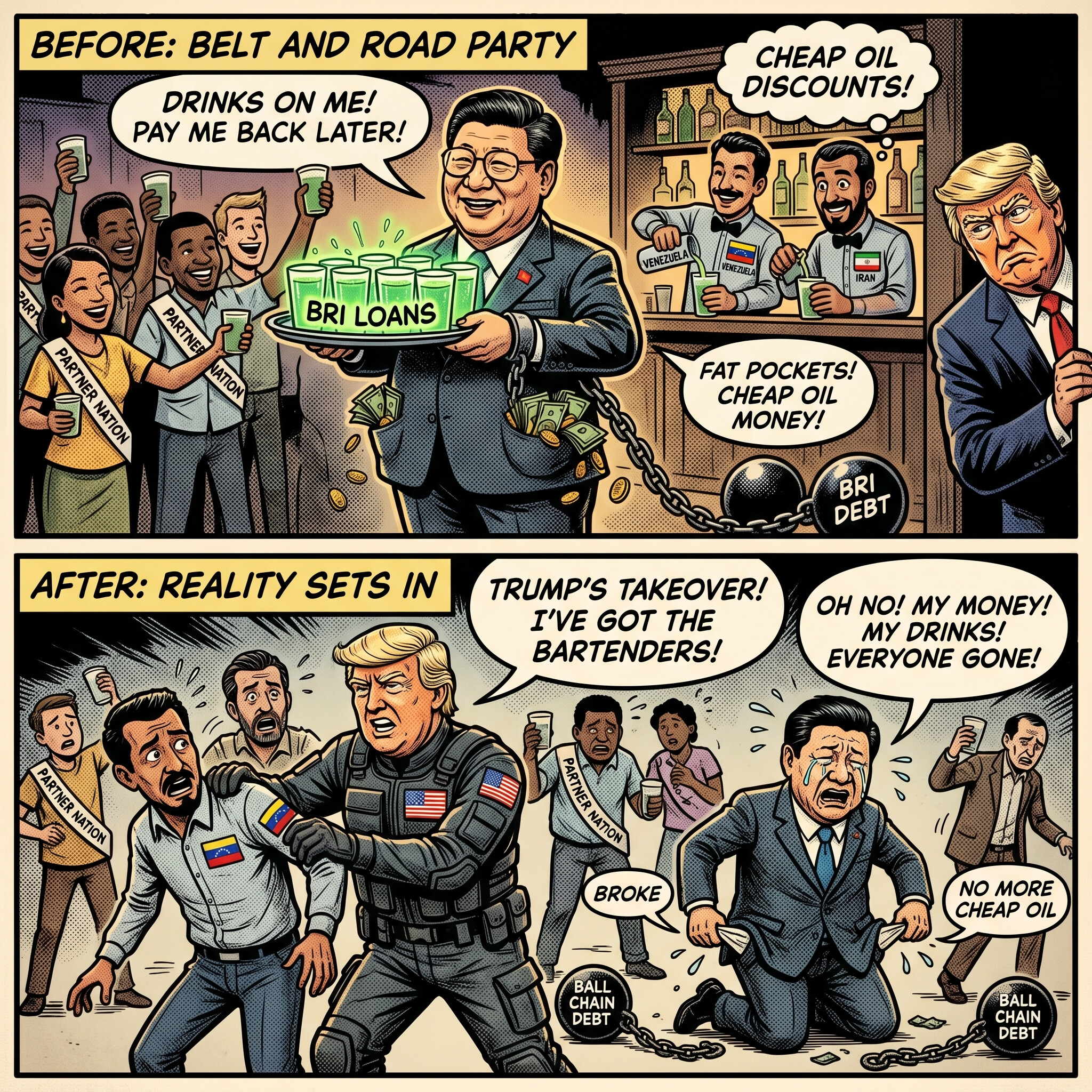
For years, China held a VIP tab at the world’s most exclusive oil bar — Venezuela and Iran pouring drinks at steep discount while the Belt and Road party roared. Then the bouncers arrived.
Henry Kissinger once observed that control of oil means control of nations. It is a sentence that has aged remarkably well. And if you want to understand why President Trump’s actions against Venezuela in January 2026 and Iran shortly after are far more consequential than the headlines suggest, Kissinger’s words are your compass.
This is not primarily a story about drug cartels, nuclear weapons, or regime change for its own sake. At its core, it is a story about China — the world’s second-largest economy — and a decades-long energy strategy that quietly helped fund the biggest military buildup on the planet since the Cold War. And it is the story of how one president identified that strategy, mapped it out, and is now methodically dismantling it.
The Bar Was Open & China Had the Best Seat
Picture a bar. Xi Jinping is at the center table. His pockets are bulging. Venezuela’s Nicolás Maduro is behind the bar, pouring discounted heavy crude. Iran’s Ayatollah is co-bartender. Russia’s Putin is running backup supply. The Belt and Road partners — over 150 nations — are raising their glasses, toasting Chinese infrastructure loans and new highways. Everyone is smiling. The tab is running. And Trump is watching from outside the window.
That image is not a metaphor invented for effect. It is the geopolitical reality that a House Select Committee on China report confirmed in early 2026: China had built an elaborate, systematic network to purchase sanctioned oil from Iran, Russia, and Venezuela at steep discounts — a network shielded by a shadow fleet of tankers, falsified documents, and shell companies operating across the globe.
The math behind those discounts is staggering. When you are buying 1.4 million barrels of Iranian oil per day at $8 to $10 below market price, you are saving the equivalent of over $4 billion per year on that single supply line alone. That is not grocery money. That is military-grade economic advantage — and it had been running for years, largely beneath the radar of Western media coverage.
Venezuela’s flagship Merey heavy crude was being sold to China at discounts reaching $21 below the Brent benchmark by December 2025. Over 80 percent of Venezuela’s oil exports flowed to China. The country’s total oil exports amounted to approximately 0.9 million barrels per day — the overwhelming majority of it destined for Chinese refineries, often partially used to repay the roughly $50–60 billion in loans China had extended to Caracas.
China’s Military Buildup: The Fuel Behind the Growth
To understand why cheap oil matters this much, you have to understand what China did with the economic advantages it accumulated. Since 2013 — the same year Xi Jinping formally launched the Belt and Road Initiative — China has been on a military spending trajectory that has no peacetime parallel in modern history.
From 2013 to 2015 alone, China posted double-digit defense budget increases: 10.7% in 2013, 12.2% in 2014, 10.1% in 2015. The pace has moderated since — but only in terms of percentage growth. The raw dollar figures keep climbing. In 2012, China’s defense spending was one-sixth that of the United States. By 2024, it had grown to one-third. And independent analysts at SIPRI and the International Institute for Strategic Studies consistently estimate actual spending runs $70–90 billion higher than Beijing’s official figures.
The nuclear dimension is especially alarming. China’s stockpile reached an estimated 600 warheads in 2025, more than tripling since 2019. The U.S. Department of Defense forecasts that number could reach 1,500 by 2035 — putting China in near-parity with both the United States and Russia simultaneously. That is not a defensive posture. That is a great-power ambition backed by numbers.
The question that rarely gets asked: where did the money come from? GDP growth is part of the answer. But cheap energy — systematically purchased below market at a savings of billions per year — is the silent subsidy that Western analysts often overlook.
The Belt and Road: Xi Pays for the Round
The Belt and Road Initiative, launched by Xi in 2013, is the most ambitious infrastructure financing scheme in human history. By mid-2025, cumulative Chinese BRI engagement had reached $1.308 trillion across roughly 150 countries. In 2024 alone, China committed approximately $121.8 billion in new BRI deals — a 31% increase over 2023. The first half of 2025 set records again, with $124 billion in combined construction contracts and investments in just six months.
The BRI is often described as a development initiative. That framing is not wrong, but it is incomplete. In the bar scene analogy, China is the financier — the one buying drinks for every nation in the room, building ports, highways, railways, and power plants across Asia, Africa, Latin America, and the Middle East. The loan terms can be generous or extractive depending on the country. In several cases — Zambia, Pakistan, Sri Lanka — they proved unsustainably heavy. But the strategic purpose is consistent: put China at the center of global trade networks, cement political influence, and expand Beijing’s sphere of leverage.
The energy that powered this financing drive — including the military expansion running alongside it — was substantially subsidized by discounted oil. Venezuela and Iran were not incidental players in the BRI ecosystem. Venezuela had received roughly $24 billion in Chinese loans, and Iran approximately $30 billion. Both nations were repaying those debts partly in oil — cheap oil, moving through shadow fleets, relabeled as Malaysian or Brazilian crude, absorbed by Chinese teapot refineries in Shandong province.
“This investigation brings to light key information on how the Chinese Communist Party keeps the economies of Iran and Russia afloat while fueling its own authoritarian agenda.”
Rep. John Moolenaar — Chairman, House Select Committee on ChinaBy early 2026, the House Select Committee’s “Crude Intentions” report documented that China had stockpiled a strategic petroleum reserve of approximately 1.2 billion barrels — equivalent to roughly 109 days of seaborne import coverage — purchased at well below market cost from the very barrels Western sanctions were designed to strand. The party was being funded, and the bar tab was enormous.
The Shadow Fleet: How the Drinks Got Served
The mechanics of how this worked deserve their own chapter, because the scale and sophistication of the sanctions evasion infrastructure is extraordinary.
China, Iran, Russia, and Venezuela did not simply ignore U.S. sanctions and announce it. They built an entire parallel logistics industry to obscure the trade. This is what analysts call the “shadow fleet” — and it is massive.
Lloyd’s Shadow Fleet Tracker identifies roughly 1,400 vessels predominantly moving sanctioned Russian oil. For Iranian oil, Kpler maritime intelligence data shows that in 2025, 251 vessels were loaded with sanctioned Iranian crude — 217 of those (86%) were themselves sanctioned vessels. Of those tankers, 96% conducted dark ship-to-ship transfers, 77% spoofed their GPS location data, and 72% turned off their vessel location beacons for extended periods.
The geographic deception was equally elaborate. China officially records zero oil imports from Iran. Yet Iran clearly exports millions of barrels to China. How? The crude is offloaded ship-to-ship in the waters off Malaysia, relabeled, and enters China as “Malaysian” oil. China’s imports from Malaysia grew from just 5,400 barrels per day in 2015 to 1.4 million barrels per day by 2024 — far exceeding Malaysia’s entire domestic production. Over $1 billion in Venezuelan crude arrived in China with falsified certificates labeling it as oil from Brazil.
“The more fraught a barrel becomes, the more it generates a profit for its buyer and a discount for its seller,” noted a senior analyst at maritime intelligence firm Kpler. China understood this calculus perfectly. The higher the geopolitical risk on a barrel of oil, the steeper the discount China could negotiate — and the thinner the margin available to the sanctioned seller who needed a buyer of last resort.
Trump Sends in the Bouncers
Many observers looked at Trump’s tariffs rolled out in March 2025 and saw a trade war. They were not wrong — but they were only seeing part of the picture. The tariffs were aimed squarely at China’s trade advantages and the manufacturing imbalance. They were the first lever.
Then came the second lever — and it hit in a location most analysts were not watching closely enough.
March 2025
Global tariffs rolled out targeting Chinese trade advantages. The opening move in a multi-front economic strategy.
December 31, 2025
OFAC sanctions four companies in Venezuela’s oil sector and identifies four associated tankers as blocked property — the warning shot before the strike.
January 2026
U.S. forces detain Venezuelan president Nicolás Maduro. Shadow fleet tankers seized. Venezuelan oil flows to China stall. The bartender gets dragged out of the bar.
Early 2026
U.S. and Israel launch military action against Iran, targeting its nuclear program. Iranian oil infrastructure threatened. The second bartender is under pressure.
Ongoing 2026
Strait of Hormuz blockade imposed. China’s attention diverted from the Taiwan 2027 timeline. Energy security becomes Beijing’s most urgent crisis.
The Venezuela move was described in the media as being about drug trafficking and the security threat from cartels. That story is real. But the deeper story — the one that connects the Venezuelan raid to the Iran strikes to the Strait of Hormuz — is about oil. Always oil. And specifically, about the discounted oil pipeline flowing from both nations directly into the economic engine that has been funding China’s military ambitions for over a decade.
Venezuela was China’s bartender. Iran was the co-bartender. Trump removed them both.
What This Costs China: The Economic Reckoning
The strategic damage to China from losing access to deeply discounted Venezuelan and Iranian oil is not simply a budget line. It is a multiplier that touches several dimensions of Beijing’s power simultaneously.
First, the direct financial hit. China invested an estimated $50–60 billion in Venezuela over the years, of which $10–15 billion was in loans secured by oil deliveries. With Maduro removed, a significant portion of those oil-backed debt repayments will never arrive. The Carnegie Endowment for International Peace noted that Chinese investment in Iran from 2005 to 2025 totaled approximately $4.7 billion — and the Iran-linked projects inside Venezuela alone totaled an additional $4.7 billion. These are losses that cannot be easily recovered in Western courts, given Iran’s own sanctioned status.
Second, the impact on the teapot refineries. The small independent refineries in China’s Shandong province — which built their entire business model around access to cheap sanctioned crude — are the most exposed sector. They operate on thin margins, lack long-term supply contracts, and depend on spot cargoes of discounted oil. Without Venezuelan and Iranian supplies, they face an existential squeeze.
Third, the strategic reserve math. China’s 1.2-billion-barrel reserve provides a buffer — roughly 109 days of seaborne import coverage. That is significant. But it is not unlimited. And the price at which future barrels must be purchased, through legitimate channels, will be substantially higher. The era of $21-below-market Venezuelan crude and $8-to-$10-below-market Iranian crude is being systematically dismantled.
“Taking out Iran as a threat and a supplier of steeply discounted oil to China is a severe blow to Chinese power.”
Bart Marcois — Foreign Policy Analyst“This blockade of the Strait of Hormuz is really an economic lever that the President is pressing hard now on Iran and indirectly on China.”
Maj. Gen. Bob Dees (Ret.) — U.S.-Israeli Affairs ExpertRetired Major General Bob Dees framed it in terms of national power levers — military being one, economics being another. What is playing out in the Persian Gulf is not purely military action. It is an economic pressure campaign aimed at the singular vulnerability in China’s growth model: its dependence on imported energy to feed its economy and fund its expansion.
The Strait of Hormuz: The Ultimate Chess Move
In 2024, the Strait of Hormuz served as a passage for an average of 20 million barrels of oil per day — equivalent to approximately 20% of global consumption, and over a quarter of all seaborne oil trade globally. It is arguably the most strategically important body of water on earth.
The U.S. blockade of the Strait — whether formal or functional through military dominance — is the chess move that ties all the other pieces together. Foreign policy analyst Bart Marcois described it plainly: “We are at complete loggerheads with China. Unless China decides it will buy its oil from the GCC countries on the other side of the Gulf, this is a policy aimed partially at China.”
Here is why the Hormuz dimension is so significant: China relies on foreign suppliers for approximately 70% of its oil, much of it delivered by sea routes that could be blockaded by U.S. and allied naval forces during a crisis — particularly one involving Taiwan. That vulnerability prompted Chinese leaders to declare energy security an “urgent requirement in great-power competition.” The 1.2-billion-barrel strategic reserve is China’s answer to that vulnerability. But the reserve has a shelf life, and refilling it under current conditions means paying market prices through legitimate channels — likely via the Gulf Cooperation Council nations on the other side of the Strait.
Marcois concluded with a prediction worth noting: “I expect de-escalation from China. They need a stable energy supply, and President Trump has wisely called that into question.”
The genius of the Hormuz blockade, in strategic terms, is that it simultaneously forces China’s hand on energy, diverts Beijing’s attention away from its stated 2027 timeline for a Taiwan contingency, and stretches Russia’s attention away from Ukraine. Three threats, one geographic chokepoint.
Watch: Expert Analysis on China, Iran & the Oil Chess Game
The following interview features subject matter experts breaking down exactly how the Iran conflict, the Strait of Hormuz blockade, and China’s discounted oil strategy are all connected. This is required viewing for anyone trying to understand the full picture.
What This Writer Has Been Watching Since 2013
For those who follow Prophetic Gems, this geopolitical collision is not a surprise. Since 2013, this ministry has been tracking what was revealed as a future war involving China and Russia — a confrontation that seemed distant when first discussed but grows more clearly visible with each passing year. The foreshadowing and setup are no longer subtle. They are visible in satellite imagery, in tanker tracking data, in congressional reports, and in the daily dispatches from the Persian Gulf.
What we are watching is not isolated policy. It is the systematic dismantling of an adversary’s economic foundation. Venezuela and Iran were not just rogue nations causing regional instability. They were the primary suppliers in a global discount-oil infrastructure that helped fund China’s rise — its military buildup, its BRI expansion, its growing nuclear arsenal, its long-term play for Taiwan and Pacific dominance.
Trump saw the full chess board when others were staring at individual squares. Whether one agrees with his methods or not, the strategic coherence of what has unfolded since January 2026 is difficult to dismiss. The tariffs were the opening. Venezuela was the second act. Iran is the third. The Strait of Hormuz blockade is the closing argument.
Xi still has money. But the paparazzi have the pictures: cheap bottles of wine where the premium labels used to be. Pockets that no longer overflow. A party that is quieter than it was.
America is on a collision course with China and Russia — not because anyone necessarily wants war, but because the strategic interests of these nations are increasingly incompatible, and the economic scaffolding that supported China’s ascent is now under deliberate, sustained pressure. Where this ends remains to be seen. But what began in 2013 as a prophetic warning is looking less like prophecy and more like front-page news every week.
The bar is closing. Last call has been announced. And this time, Xi is picking up the tab at full price.

Leave a Reply