 by
by 
PropheticGems.com — Make Something Happen
For months, my family went church-hopping looking for a home. We’d find a nice church, sing the songs, say “Amen” when the Pastor preached something good, laugh at the jokes, and get lifted during praise and worship. We might shake a few hands. And then we’d walk out to the parking lot and go our separate ways — back to being strangers until the next Sunday.
One day it hit me: this is exactly like going to a baseball game. We root for the same team. Somebody gets a base hit and we cheer. Somebody hits a home run and we high-five the person next to us. But when the game is over, everybody leaves the stadium and goes home alone. Church had become a ballgame with strangers. We were on the same team — but we were not a family.
That is why I started my own ministry. Not out of bitterness toward the church, but out of a burden for it. Because here is what I have come to believe after looking hard at this: the church in America is not short on belief. It is short on belonging. And belonging is something we can rebuild — if we are willing to wake up.
A Church With a Reputation for Being Alive
There is a letter in the Bible written to a church that thought it was doing great. In Revelation 3, Jesus dictates short messages to seven churches, and the one to the church in Sardis is the one that has had me up at night.
“I know all the things you do, and that you have a reputation for being alive — but you are dead. Wake up! Strengthen what little remains, for even what is left is almost dead.” (Revelation 3:1–2)
You do not have to be a Bible scholar to feel the weight of that. The city of Sardis was once one of the richest, most glorious cities in the ancient world — but by the time this letter was written, it was a faded has-been living off its old reputation. The church mirrored its city perfectly: a big name, a dead reality. It had a reputation for being alive. And it was the only one Jesus did not commend for anything.
That is the part that should make every one of us pause. This was a church that passed its own inspection and failed God’s. If you are a member, you tend to think your Pastor and your church are doing great — and when somebody leaves, you assume they just did not want to serve God. Sometimes that is true. But sometimes the truth is the one Jesus speaks here: you think you are alive, but you are actually dead.
I am not pointing fingers at any one church. I am describing what I see across the country. And the numbers back it up.
The Numbers Behind the Diagnosis
Here is the strange thing about America: we still believe. What we have stopped doing is belonging.
According to Pew Research, around 83% of U.S. adults still believe in God or a higher power, and roughly 86% believe people have a soul or spirit. Eight out of ten Americans say there is something spiritual beyond the natural world. The belief is there.
But look at what happens when you go from believing to showing up:
- Identify as Christian: about 62% of adults — down from 78% in 2007.
- Belong to a congregation: only about 45%, according to Gallup — the first time in over 80 years of tracking that membership fell below half. As recently as 1999 it was 70%.
- Show up even monthly: roughly a third.
And here is the verse that haunts me most. Even among Americans who still claim a religion, formal membership in a congregation dropped from about 73% twenty-five years ago to roughly 60% today. These are believers — people who say they love God — who are no longer part of any body. They kept the faith. They just stopped showing up.
That gap between “I believe” and “I belong” is the whole problem. It is church as something you do once in a while, like a ballgame, instead of something you are.
The Real Mission Field Is Hiding in Plain Sight
Jesus said the harvest is plentiful but the laborers are few (Matthew 9:37). We quote that verse all the time. But think about what it actually means right now.
The mission field is not a nation of godless atheists. Most Americans already believe in God. The harvest is the tens of millions of people who believe but are not connected to anything — the ones who pray in the car, watch a sermon online, maybe show up on Easter, but have no family of faith around them. They do not need to be convinced God exists. They need to be shown that the church is relevant to their actual lives.
And what are we offering them? Be honest. For most churches the whole operation is a sermon and a few songs on Sunday — about two hours — and a Wednesday Bible study that only a handful of people attend. That is it. Four hours a week, if you are generous.
The harvest is plentiful but the laborers are few — and the laborers are only clocking in four hours a week. We are not working much. We are enjoying our lives quietly with our own families, and the church is an afterthought. And here is the law I keep coming back to: when the church is an afterthought, it becomes disposable.
We Are the Most Connected — and the Loneliest — Generation Ever
We live in a 24-hour-a-day, seven-day-a-week world. We are on our phones constantly — checking the news, watching videos, scrolling social media. The average American now spends around six hours a day on digital media, and one in three adults says they are online “almost constantly.”
So you would think we would be the most connected people in history. We are the opposite. In 2023 the U.S. Surgeon General released an official advisory declaring loneliness and isolation a national epidemic. About half of American adults report being lonely. Social isolation raises your risk of an early death by nearly 30% — the report compared its effect to smoking fifteen cigarettes a day. And get this: as far back as 2018, only 16% of Americans said they felt very attached to their local community.
We are drowning in connection and starving for community. People are scrolling through hundreds of “friends” and dying of loneliness.
Now here is what I cannot get over. Meta, Google, every AI company, every major brand on earth is spending billions trying to figure out how to be more present in your life. More in your pocket. More in your day. And the church — the original 24/7 family — looks at the same world and basically says, let us be less in your life. See you Sunday.
The greatest opportunity the church has had in a generation is hiding in plain sight. The world is begging for the exact thing the church was built to provide. We are just not providing it.
Why Men Are Walking — and Why That Is About to Change
I want to talk about men, because this one is personal.
A lot of men do not go to church, and I think I know why, because of how I have been treated. Men do not want to be in a place where they do not feel like they can be a man. A man can go to a football game and feel like a man. He can go to a basketball game and feel like a man. But a lot of guys walk into a church and feel like they cannot. Some men also stay away because of the way churches are set up — they worry that if their wife or girlfriend goes, she becomes “one of the Pastor’s ladies.” That sounds harsh, but a lot of men feel it, and the way some churches operate, the concern is understandable.
For most of the last twenty-five years, the data agreed with that experience. Women filled the pews; men were the missing demographic. Around the year 2000, women were out-attending men by a wide margin, and there were whole books written about why men hate going to church.
But something has flipped — and this is the part that should light a fire under us. According to Barna’s most recent research, men are now attending church at higher rates than women: about 43% of men versus 36% of women, the widest gap in that direction Barna has ever recorded. Married fathers are now the single most likely group to be in church on a given Sunday. And researchers say young men in particular are leading a surprising surge of people recommitting their lives to Jesus.
Read that again. Men — especially young men — are spiritually hungry right now. They are looking for something real. The door is open. The only question is whether the church will give them a place to be men, to lead, and to belong — or whether they will go looking for it somewhere else, or nowhere at all. That is exactly the gap my ministry is built to fill.
Young People Are the Future, and We Are Losing Them at the Door
The same is true for our young people, and the stakes could not be higher. They are the future. They are the parents who will raise the next generation and lead the church one day. And we are losing them.
Lifeway Research found that 66% of churchgoing teenagers stop attending for at least a year between the ages of 18 and 22. Barna puts the number of young adults who grew up in church and later dropped out at nearly two-thirds — and rising.
But here is the detail that proves my whole point. When researchers asked these young people why, most of them had not had a crisis of faith. They did not march off to college and lose Jesus. They just drifted — and the time they used to give the church simply got filled up by something else. There was nothing about their church experience that made them want to seek out a body of believers in their new life. We had them as children, and we did not give them a reason to stay as adults.
A boring, hands-off church loses its young people and its men. And a church that loses its young people and its men is, by definition, losing its future.
The Church Is a Juggernaut Lying Dormant
Now picture what the church could be if we did this right.
When you build a real family of faith — people who know what is going on in each other’s lives, who pull the same direction, who hold each other accountable — you are not just running a service anymore. You are building an economic, mental, emotional, spiritual, financial, and physical juggernaut. A force. A people where there is no question that you are cared for, no question that you can depend on each other, no question that someone has your back.
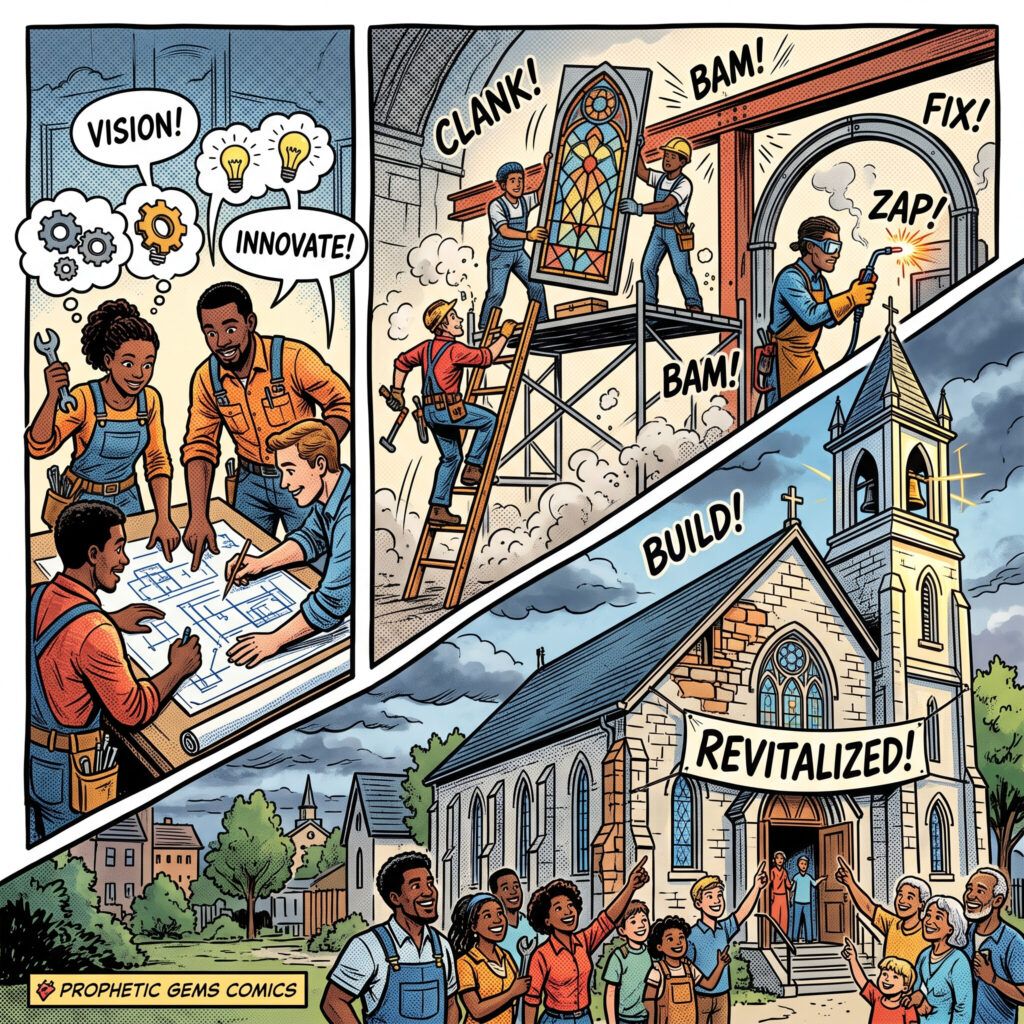
That potential is sitting there, dormant, in nearly every congregation in America. And too often we bury it under bureaucracy. I heard somebody describe how some of the biggest churches have gotten so corporate that they are basically just functioning to pay the bills — this staff member and that staff member, this department and that department — and you have to ask: are we really getting our money’s worth out of all that, beyond a couple hours of preaching and gathering a week?
I am not against organization. But some folks pride themselves on the organization more than the people. “This is how it works, you have to do this and you have to do that.” How about we just live? How about: how are you doing, what do you need, what is going on this week? “My teenager has a basketball game Thursday.” Oh yeah? What time? We’ll be there.
That is not compromise. I am not saying water down the truth. I am saying refit the factory. The factory needs an upgrade. The product is still the gospel; the delivery is what is broken.
My Idea: A 24/7 Church Life
So here is the vision. I believe the church needs to be more involved in people’s lives — not overly involved, not controlling, but present. The church needs to become more like a family. We need more aunties and uncles. We need more brothers and sisters. We need more mamas and daddies. We need to network more, support each other more, and actually know what is going on in each other’s lives.
That means being intentional and doing it on purpose. Here is some of what that looks like in practice:
- Pray together more — even just gathering to pray where nobody has to say a word.
- Get in the Word together and share our faith outside the building, not just inside it.
- Serve, hands-on. Get a few people together, pool fifty dollars, go find a homeless brother and talk to him. See a struggling family at the grocery store and help them — in the name of Jesus. Strangers have blessed me in my life in ways that still bring me to tears, and they never said the name of Jesus when they did it. I want to do it and say His name.
- Support each other’s businesses. This is something you almost never see in church. Somebody’s sister opens a coffee spot — let us go support sister’s coffee spot. Imagine being in tears because the church did not just hand you money, but kept your business alive by showing up for what you built. The Bible says be not slothful in business (Romans 12:11). A church that helps its people thrive financially is a church people will never want to leave.
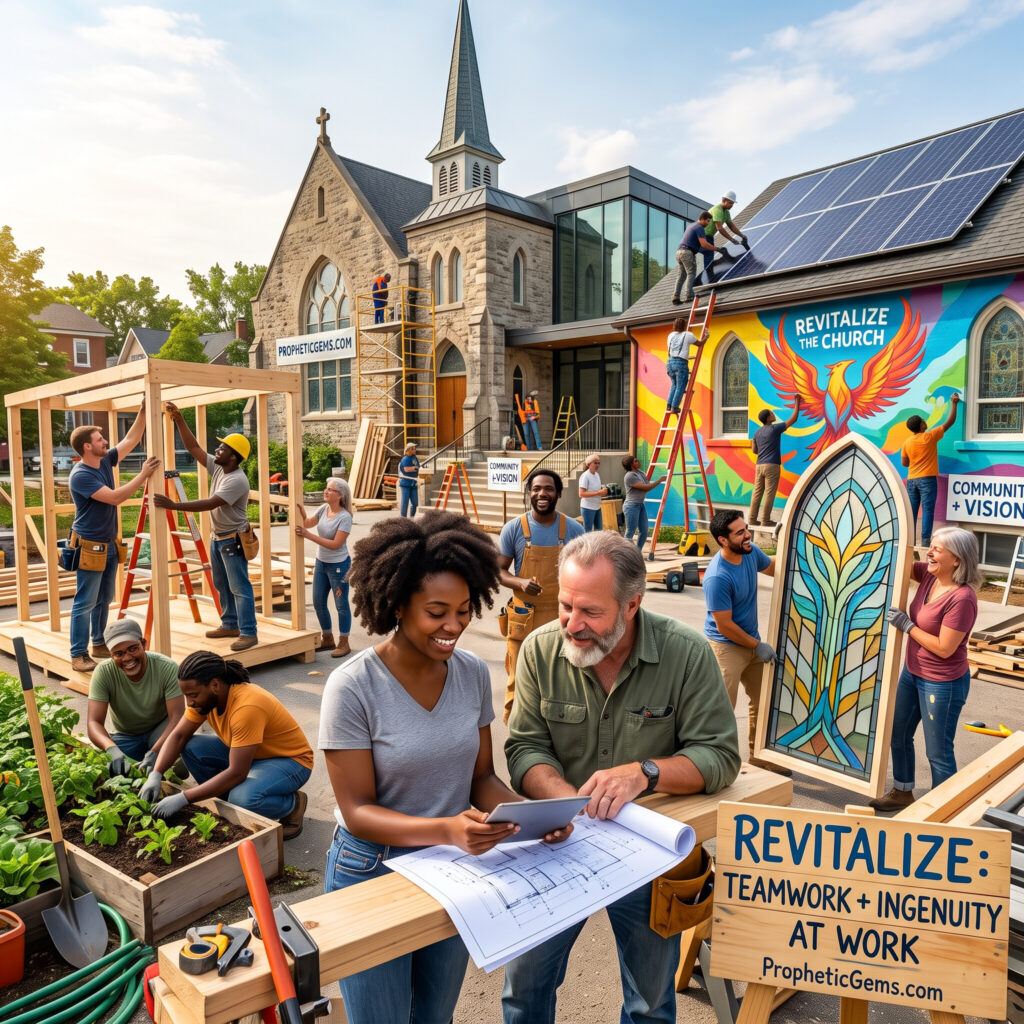
Jesus showed us how to do all of this. He was a people person. He rubbed elbows with everybody — that was the whole point. And honestly, that is what I think is missing most. Too many church people are not good with people. They act too good to do the very thing Jesus did. You cannot revitalize a dead church from behind a pulpit and a parking-lot goodbye. You do it by getting into people’s lives the way our Savior got into ours.
How This Works: A Ministry That Serves the Church
Let me be clear about my heart here, because this matters. My ministry will always be separate from the church, and its goal is to support the church — never to pull people away from theirs.
Think of it like a meal. Your church might be the potatoes and the broccoli — the foundation, the staple, the weekly gathering. What we do is the steak supreme on top of what you already need. We are here to add to the body of Christ, not subtract from it. My calling is to use my prophetic gift, my teaching, and real everyday help for people’s lives — the way Jesus and the Apostles did it. Not just a sermon on Sunday and a sparse Bible study on Wednesday, but a 24/7, seven-day-a-week family that goes deeper, gets stronger, and reaches further.
Coming Back Online
When I say I want to bring the church “back online,” I do not mean online to the internet. I mean back online from being dead.
That is the language of Sardis. “Wake up. Strengthen what remains.” And notice how Jesus introduces Himself in that letter — as the One who holds the sevenfold Spirit of God. To a dead church, He shows up holding the very thing it was missing: life. The fix for a dying church was never another program or another committee. It was the Spirit it had stopped depending on — and, I would add, His people being present and passionate in each other’s lives the way He was in ours.
There is hope in that letter, too. Jesus told the faithful few in Sardis who had not given up that He would dress them in white and never blot their names out of the book of life. He sees the ones who are still awake. He always has.
So this is my rebellion against a four-hours-a-week, afterthought, ballgame-with-strangers Christianity. I want to build something people feel a part of — something they will talk about, plant their flag in, and tell others about. A church and a ministry that is a family. That serves God and people. That is alive in reputation because it is alive in reality.
The harvest is plentiful. Let’s stop clocking out at four hours a week.
Let’s make something happen.
Cedric Powell writes at PropheticGems.com on faith, current events, and the prophetic. Building a 24/7 family of faith in Hampton Roads and beyond. 757-681-8900.

Leave a Reply