 by
by 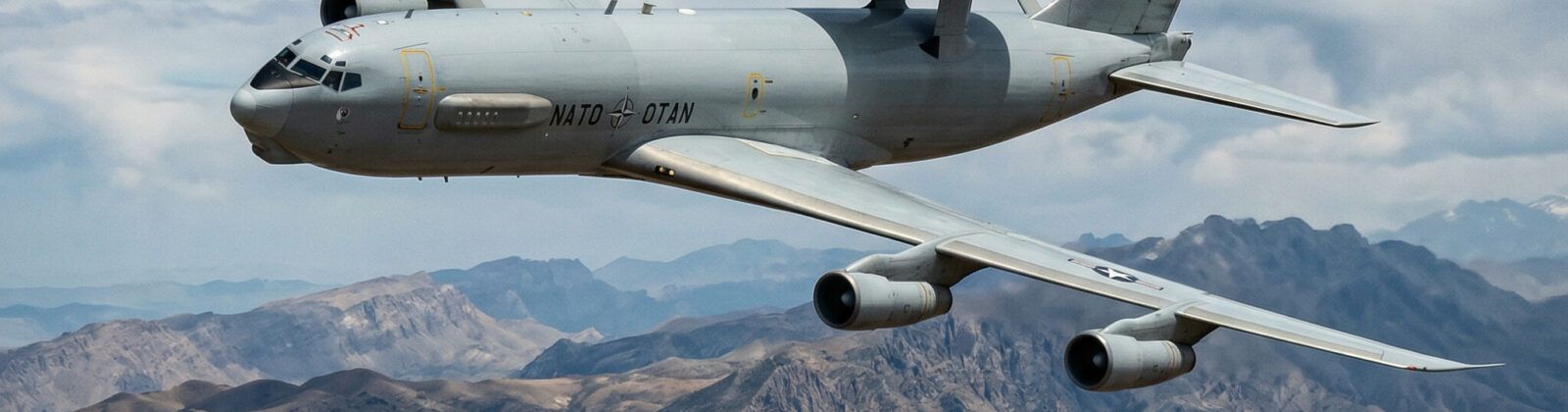
Iran Hit the E-3 Sentry: Can America Afford the Maximum Carnage of World War III?
Your Prophetic Platform World War III Watch
Analysis · March 30, 2026 · Iran Conflict
Iran Hit the E-3 Sentry. Can America Afford the Maximum Carnage of World War III?
One aircraft. Sixteen in the entire fleet. No replacement on the production line. And our adversaries are taking notes.
Cedric Powell · Updated March 30, 2026
This is a layup. This is a slam dunk. And our adversaries know it. Iran is able to pick apart America’s most vital military machines with weapons that cost a fraction of what we are losing — and the clock is ticking on our ability to replace them.
What Just Happened in Saudi Arabia
On the night of March 27, 2026, Iran launched a coordinated missile and drone strike on Prince Sultan Air Base, located roughly 60 miles southeast of Riyadh, Saudi Arabia. The base is a major hub for American air operations in the conflict that began February 28 — what some are calling Operation Epic Fury. When the smoke cleared, at least 10 to 15 American service members were wounded, some seriously. Multiple KC-135 air refueling tankers were damaged. And one of the most strategically valuable aircraft in the United States Air Force inventory — an E-3G Sentry AWACS — was burned out on the tarmac, its tail severed from its fuselage, its radar dome destroyed.
Satellite imagery, ground-level photographs, and flight tracking data all confirmed what military analysts feared most: this was not random. Iran knew exactly what it was hitting.
“It’s certainly not random. It seems like it is a deliberate campaign to go after the critical enablers of U.S. airpower.”
Kelly Grieco — Defense Policy Expert & Senior Fellow, Stimson Center
Ukrainian President Volodymyr Zelensky added a chilling detail in an NBC interview: Russian satellites photographed Prince Sultan Air Base on March 20, March 23, and March 25 — just before the strike. Whether Russia passed that intelligence directly to Iran is disputed in Washington. But the accuracy of the attack speaks for itself.
“Iran, by attacking radars, communications sites, aircraft, and bases, appears to be attempting to conduct an asymmetric counter-air campaign.”— Kelly Grieco, Stimson Center, to Air & Space Forces Magazine, March 28, 2026
What Is the E-3 Sentry — And Why Does It Matter So Much?
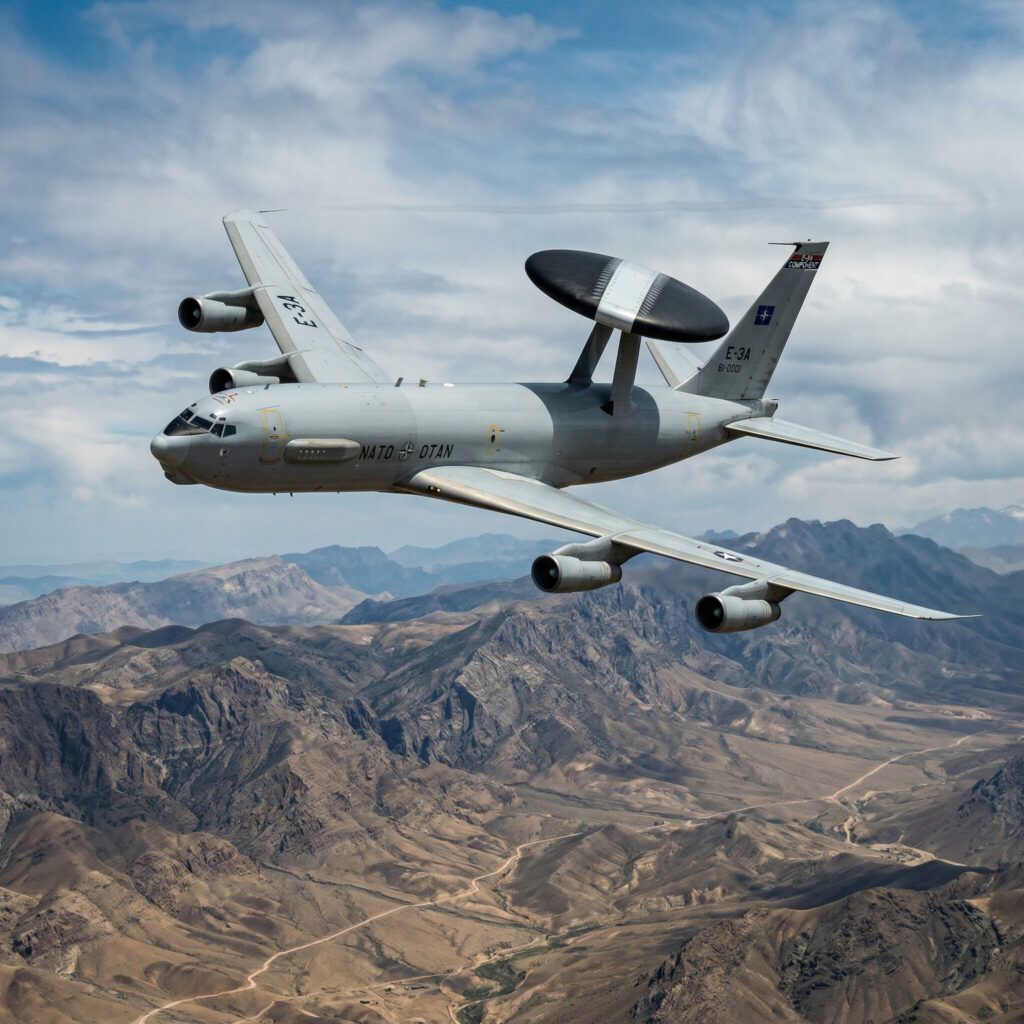
The Boeing E-3 Sentry has one of the most important and least-glamorous jobs in modern air warfare: it sees everything so that everyone else can win. Built on a modified Boeing 707 airframe, the E-3 carries a massive rotating radar dome — 30 feet wide, 6 feet thick — mounted above the fuselage. That dome can track targets 250 miles away, from the surface to the stratosphere, in all weather, day or night. It can distinguish low-flying drones from ground clutter. It can track dozens of aerial targets simultaneously. And it functions as an airborne command post, linking bombers, fighters, and ground commanders into a single, unified operational picture.
Think of it this way, as former F-16 pilot and Mitchell Institute director Heather Penney described it: fighter pilots are bishops on the chessboard. The E-3 is the chessmaster. The bishops cannot see the full board. The chessmaster can.
“The value of the E-3 and the battle managers is they see the big picture. They’re the chessmaster, while fighter pilots are the bishops.”
Heather Penney — Former F-16 Pilot & Director of Studies, Mitchell Institute for Aerospace Studies
Since its introduction in 1977, the E-3 Sentry has been the backbone of every major American air campaign. During Operation Desert Storm in 1991, E-3s flew more than 7,000 hours, controlled over 30,000 air strike sorties, and assisted in 39 of the war’s 41 Allied air-to-air kills. The aircraft served in Kosovo, Iraq, Afghanistan, and the counter-ISIS campaign. Production ended in 1992 — meaning these planes are now averaging 45 years of age. They are approaching the end of their service lives, and they have no easy replacement waiting in the hangar.
The Air Force started with 31 E-3s. Over the past several years it retired roughly half the fleet — cutting it to 16 operational aircraft to improve sustainment on the remaining planes through a planned phase-out around 2029. Of those 16, six were deployed to the Middle East ahead of the conflict with Iran. One is now gone. One is possibly partially damaged. That leaves, at best, 15 E-3s in the entire U.S. inventory.
By the Numbers
The E-3 Sentry Fleet — Then, Now, and After
68Total E-3s ever built (production ended 1992)
16U.S. fleet before the Iran war began
6Deployed to the Middle East for Operation Epic Fury
56%Mission-capable rate in FY2024 (barely half could fly at any time)
- The E-3 can surveil airspace across a 250-mile radius — surface to stratosphere
- Of the 16 aircraft before the war, 6 were in the Middle East, 1 in Alaska, 1 in Japan, and 8 in maintenance
- The March 27 strike destroyed serial #81-0005, assigned to the 552nd Air Control Wing, Tinker AFB, Oklahoma
- The nearest replacement — the Boeing E-7 Wedgetail — is projected to cost over $700 million per aircraft
- Congress added $649 million to the FY2026 NDAA to keep the E-7 program alive after the Pentagon tried to cancel it
The Cost Problem: When Cheap Weapons Beat Expensive Ones
Here is where the math gets punishing. Iran is not fighting a symmetric war. It is not trying to match America dollar for dollar. It doesn’t need to. It needs to punch America in the nose — and keep punching — until the economic cost becomes unbearable.
Iran’s ballistic missiles cost roughly $500,000 to $2 million apiece. Its attack drones run approximately $20,000 each. Those weapons are being used to destroy assets that cost hundreds of millions of dollars. That is not a war of equals. That is a war of asymmetric economics — and the math heavily favors the side with cheaper weapons.
What Things Cost: The Asymmetry of This War
Iranian attack drone (est.)
~$20,000
Iranian ballistic missile (est.)
~$1M
F-35A fighter (approximate)
~$80M
E-3 Sentry AWACS (original)
~$270M (1992 dollars)
E-7 Wedgetail (replacement)
$700M+ per aircraft
Note: Bars are illustrative of relative scale. Sources: WSJ, Air & Space Forces Magazine, DoD estimates.
The losses in this conflict are already mounting in ways that deserve careful accounting. Six Army reservists were killed in a drone strike in Kuwait on March 1 — the day the U.S. and Israel launched their war on Iran. Multiple KC-135 refueling tankers have been hit at Prince Sultan. An F-35 was struck but landed safely — damaged but not destroyed. Since the war began on February 28, more than 300 U.S. service members have been wounded and 13 killed in action. Every one of those losses — human and mechanical — has a replacement cost.
“The E-3 has long outlived its service life and paid for itself years ago. The real cost lies in mission impact and training crews for the future. That is the true cost of losing an airborne platform within such a small fleet as the E-3.”
Gen. Glen VanHerck (Ret.) — Former NORAD Commander, U.S. Air Force, to The Wall Street Journal
America’s Factory Problem: We Cannot Build Fast Enough
This is the core problem that this conflict has laid bare — and it is one I have been watching for years. America’s military industrial manufacturing base is already behind. We are not as prolific as we need to be in producing both offensive and defensive weaponry. And this is not a new problem. It is a structural one that goes back decades, rooted in the offshoring of American manufacturing capacity to China and elsewhere.
Consider what happened during World War II. The factories that were making automobiles in 1941 began making tanks and military equipment within months of Pearl Harbor. That pivot was possible because America had a massive, distributed, domestic manufacturing base. You cannot do that pivot today if the factories don’t exist.
The factories that made cars in 1941 made tanks by 1942. That pivot is only possible if the factories exist in the first place.
This is precisely why Trump’s tariff policies, whatever you think of them politically, have a logic that most commentators missed entirely. When Trump came into his first term in 2017 emphasizing the confrontation with China, many people heard an economic argument. But the deeper argument was a national security argument: America had allowed China to become the manufacturing backbone of the global economy — including the supply chains that feed the American military-industrial complex.
Since 2013, China has dramatically accelerated its military power. It has done so using the industrial base that America and the West helped build by moving their own manufacturing there. The tariff policies of the second Trump term represent a recognition, however blunt in execution, that you cannot simultaneously fund your enemy’s military buildup and maintain your own strategic advantage. That is a serious geopolitical insight — and it is playing out in real time on the tarmac at Prince Sultan Air Base.
“Iran is gradually eating away at the network of early warning systems that the U.S. has built over decades in the region. Collectively, each radar or ISR platform destroyed further degrades the overall monitoring capability of the U.S.”
Andreas Krieg — Senior Lecturer, King’s College London School of Security Studies, to NBC News
The Budget Gap — And Why It’s More Complicated Than It Looks
On paper, the numbers favor America overwhelmingly. The U.S. defense budget for 2025 came in at approximately $919 billion — nearly $1 trillion. China’s official 2026 defense budget is $277 billion. You would look at that and think: the side spending nearly four times more will win. History does not support that assumption.
Military Spending: U.S. vs. China (2026)
U.S.A.
~$919B (actual FY2025 spending)
China
~$277B official (2026 budget)
China (est.)
$304B–$377B (DoD estimate, 2024)
Source: USAFacts, CNBC, U.S. Dept. of Defense 2025 China Military Power Report. China’s actual spending is estimated to be 32–63% higher than official figures due to off-budget items and civil-military fusion programs.
Vietnam cost America enormously in blood and treasure — and we lost. Afghanistan cost over $2 trillion across 20 years — and we left. Iraq cost over $2 trillion — and the strategic outcome remains deeply contested. In every case, the side with superior technology and vastly greater resources did not win decisively. Terrain matters. Political will matters. Pain threshold matters. The willingness of a nation’s population to absorb losses matters. And the economics of a prolonged conflict matter more than any single budget figure.
Here is the number that should keep policymakers awake at night: the interest payments on America’s national debt are now running roughly equal to — and in some projections exceeding — the annual defense budget. You cannot fight a multi-theater world war with one eye on your bond payments. The Axis of Evil understands this. They are counting on it.
The Multi-Theater Problem: Spread Thin and Punched in the Nose
I called this on this platform — not on any radio show, not in any think tank report, but right here on Facebook, talking to regular people. The screenshot below is dated February 26, 2022, just two days after Russia’s full-scale invasion of Ukraine began. While cable news anchors were still debating whether this was a ‘regional conflict,’ I wrote plainly to my Facebook friends: ‘Stop acting like we are not already in war with Russia and China. Because war is inevitable and really has already started.’ That was four years ago. Nobody wanted to hear it. Now look at where we are.

I admit this has to be a little scary. But we have to chin up and face the threats in front of us.
Now even Iranian leaders are using that language of World War 3 publicly. Ukraine was the first battle. Venezuela was pressure. Iran is the third front. And the adversaries — Russia, China, North Korea, Iran — are not operating independently. They are sharing information, sharing tactics, sharing intelligence on how to defeat America’s systems.
Think about what that means for the E-3 Sentry fleet. You have 15 remaining aircraft. Six were in the Middle East before the attack. Now you have, at best, five operable. What if China moves on Taiwan? What if Russia escalates against NATO in the Baltics? Each theater will demand these aircraft. Each theater exposes them to the same kinds of coordinated drone and missile barrages that just destroyed one in Saudi Arabia.
All you have to do is lose two or three in each theater — and you have lost all of them. What do you do then?
In boxing, they say all you need to do is land the right punch and the heavyweight champion goes down. The underdogs understand this. When the challenger can get past the fifth and sixth round and start wearing the champion down — physically, mentally, financially — they have a chance. America is the heavyweight champion of the world militarily. But when you fight in the enemy’s backyard, when they know the terrain and you don’t, when they can absorb losses you can’t, and when your supply lines and industrial base are stretched — respect the underdog’s punch.
Multiply this by three or four simultaneous conflict zones — the South China Sea, the Korean Peninsula, the Baltics, the Middle East — and add the economic chaos of the Strait of Hormuz being closed (through which 20 percent of global oil and gas passes, with prices already above $100 per barrel, a 40 percent jump since the war began). The math becomes genuinely alarming.
“If we’ve had this much trouble with what was considered a militarily inferior Iran, what does anybody think would happen if we had to fight on the ground, in the sea, and in the air against a Russia or a China?”
Ret. Lt. Col. Daniel Davis — Bronze Star recipient, Senior Fellow, Defense Priorities think tank, to NBC News
The Questions America Must Answer
- With E-3 production ending in 1992 and no replacement in service, how does the Air Force maintain battle management coverage as this fleet continues to shrink?
- The E-7 Wedgetail costs over $700 million per aircraft. How many can we realistically procure — and how quickly — given current defense budget pressures and manufacturing timelines?
- Why was an irreplaceable, 45-year-old aircraft worth hundreds of millions of dollars sitting exposed on a taxiway at a base that had already been attacked multiple times?
- Ukraine has been destroying Russian aircraft from thousands of miles away using long-range drones and ballistic missiles. What lesson did we fail to apply to the protection of our own assets?
- Do we have a credible industrial plan to mass-produce the military equipment required to fight — and win — against four well-armed, determined, and coordinated adversaries simultaneously?
- What is America’s pain threshold? And do we have the political will to answer these questions before the next loss — not after it?
The Replacement That Isn’t Ready
The Pentagon had a plan to replace the E-3 with the Boeing E-7 Wedgetail, a more modern aircraft built on the 737 platform with a fixed active electronically scanned array radar. In 2022, the Air Force planned to buy 26 E-7s, with the first arriving by 2027. Then, in summer 2025, Defense Secretary Pete Hegseth tried to cancel the program entirely, arguing the E-7 was not survivable in a modern battlefield and that the military would rely on space-based sensors instead.
Sixteen retired four-star Air Force generals — sixteen — wrote a public letter urging Congress to reverse that decision. The generals argued that satellites are not ready to track airborne targets. The top Space Force generals agreed. Congress sided with the generals, adding $649 million to the FY2026 National Defense Authorization Act to keep the E-7 program alive and blocking further E-3 retirements. But as of this writing, the program’s future remains unresolved — and in the meantime, the E-3s are flying their hardest missions in the final years of their service lives, with pilots and crews being trained on a platform that will be retired before new aircraft arrive.
“We’ve simply taken too much risk in the battle management career field. Space will be an incredible capability, but it is not here today. The E-7 is desperately needed to replace the E-3.”
Heather Penney — Former F-16 Pilot & Director, Mitchell Institute for Aerospace Studies, to Air & Space Forces Magazine
Looking Forward: What This War Is Teaching Us — And What Comes Next
My view — and I have been saying this since 2022 — is that we are in the opening rounds of a conflict that will reshape the world order. Iran is not the finale. It is the proving ground. Every drone strike, every ballistic missile, every piece of shrapnel that hits an American aircraft is data. Russia, China, and North Korea are collecting that data right now.
They are learning our coverage gaps. They are learning which assets we are reluctant to risk. They are learning how long it takes us to replace what we lose. They are learning our pain threshold. And then they will calibrate their strategy accordingly.
The honest assessment is this: America cannot afford a major simultaneous war against China, Russia, and North Korea — not at current manufacturing capacity, not with the current national debt, and not without a serious reckoning about what it means to be a warfighting nation in the 21st century. The world will likely force some kind of negotiated settlement before we reach that scenario — because the economic chaos of that level of conflict would be globally catastrophic. But that means compromises. Compromises with adversaries who are aggressive and emboldened. Compromises that no American administration wants to make — and that the American public will not easily accept.
The E-3 Sentry sitting burned on that Saudi tarmac is not just a military loss. It is a warning. We need to decide — right now, not after the next loss — what kind of industrial and military power we want to be. Because our adversaries have already decided what kind of power they intend to be.
We called this. The question is whether Washington is listening.
The E-3 Sentry served for nearly 50 years. It helped win the Gulf War, managed the skies over Kosovo and Afghanistan, and is now running one of the most complex air campaigns in American history — coordinating B-2 bombers, F-22s, F-35s, and naval strike assets in Operation Epic Fury. It deserved a better ending than burning on a taxiway in Saudi Arabia while Washington argues over whether to fund its replacement.
But that is where we are. And where we go from here is the most important defense question of this generation. The chessmaster can’t see the board if you take it off the table.
— ✦ —
SEO Package
URL Slug/iran-e3-sentry-awacs-can-america-afford-ww3
Meta Title (≤60 chars)Iran Hit the E-3 Sentry: Can America Afford World War III?
Meta Description (≤160 chars)Iran destroyed a U.S. E-3 Sentry AWACS at Prince Sultan Air Base. With only 15 remaining and no replacement ready, America’s military manufacturing crisis is now on full display.
Primary KeywordsE-3 Sentry destroyed, AWACS Iran attack, U.S. military budget World War 3, E-7 Wedgetail replacement, Prince Sultan Air Base strike
Secondary / LSI KeywordsAmerican military manufacturing, Trump tariffs defense, China military budget 2026, Iran ballistic missiles cost, multi-theater war U.S., asymmetric warfare
Suggested TagsIran War, World War III, E-3 Sentry, AWACS, U.S. Military, Defense Budget, China, Russia, Operation Epic Fury
Internal Linking SuggestionsLink to your 2022 World War III prediction post · Link to your Ukraine/Russia analysis · Link to any prior posts on Trump’s tariff-as-defense strategy
Recommended Featured Image Alt TextU.S. Air Force E-3 Sentry AWACS aircraft destroyed at Prince Sultan Air Base, Saudi Arabia after Iranian missile and drone strike, March 27 2026
Published March 30, 2026 · Sources: Air & Space Forces Magazine · The War Zone · NBC News · Al Jazeera · Times of Israel · Jerusalem Post · Simple Flying · Wikipedia / Boeing E-3 Sentry · CNBC · USAFacts · Task & Purpose
All military cost figures and fleet data reflect publicly reported information as of March 30, 2026. China budget figures reflect official announcements; actual spending estimated higher by U.S. DoD.

Leave a Reply